
Return to Main Grade 10-12 Course Selection Page
The decisions you make can have a huge impact on both your future opportunities and the courses we are able to offer. As a result, please take the time to do some research and talk to your parents/teachers about courses that are right for you. Choosing the same course as your friend does not mean you will be in their class.
Read the course catalogue for descriptions of courses and programs available to meet your educational goals. Please note that not all courses in this catalogue will be scheduled if student requests are too few.
- French Immersion
- English
- Mathematics
- Career Education
- Physical Education
- Science
- Social Studies
- Languages
- Fine Arts
- Applied Design, Skills and Technologies (ADST)
- Out of Timetable Courses
- Specialized Programs & Academies
French Immersion
A French Immersion “Dogwood” (Bilingual Dogwood) will be granted by the Ministry of Education to students completing Sciences Humaines 10 & 11, Francais Langue 10, 11 & 12 and one additional 4 credit course taught in French (Sciences Naturelles 10 or Education Physique 10)
Speaking French in the classroom at all times is an integral component of the program. This program is designed for students who have been enrolled in French Immersion since Kindergarten (early) or grade 6 (late). These students possess a considerable degree of fluency in the French language – orally and literary.
Note: Grade 12 students will be required to write a Provincial French Literacy Assessment to receive their Bilingual “Dogwood” Graduation Certificate. Similar to the Provincial Numeracy and Literacy Assessments written in English, this assessment does not affect a student’s overall mark in French Immersion.
Français Langue 10 (FFRAL10)
In Français langue 10, students continue to refine their skills in French through speaking, listening, reading, and writing. Themes include: verb tenses and grammar, literature, and culture. Students will complete a novel study and will broaden their understanding and appreciation of French culture through the exploration of theatre, cinema, and poetry. Critical thinking skills are also emphasized. Strategies include oral presentations, skits, creative writing and essays, dictations and research projects. Successful completion of this course is mandatory for French immersion students.
Français Langue 11 (FLCF-11)
In Français langue seconde – Immersion 11 (Langue et culture de la francophonie 11), students will reflect on how language and culture influence their personal perceptions and values. Through self-identification as students in a bilingual learning environment, they become aware of how acquiring a new language helps strengthen their Canadian identity and contributes to their personal and social development. Culture plays an important role in learning, offering students the opportunity to explore and better understand the realities of their own culture and the cultures of the French-speaking world. Through a variety of study topics, students will put into practice their language competencies while exploring and deepening their understanding of various Francophone areas.
Sciences Humaines 10 (FSCHF10)
Sciences Humaines 10 is a survey course, which means that it will introduce a wide variety of topics in modern Canada around “Big Ideas” rather than go into detail on a few topics. The historical emphasis is more on Canadian content than in grade 9 Socials.
The “Big Ideas” will include:
- How global and regional conflicts have been a powerful force in shaping our contemporary world and identities.
- Investigate how the development of political institutions is influenced by economic, social, ideological, and geographic factors.
- Analyze how worldviews lead to different perspectives and ideas about developments in Canadian society.
- Recognize how historical and contemporary injustices challenge the narrative and identity of Canada as an inclusive, multicultural society.
Explorations Sciences Humaines 11 (FEPSS11)
Students in French Immersion must take Explorations Sciences Humaines 11 as well as Français Langue Seconde – Immersion 11 to receive their Bilingual Dogwood. Explorations Sciences Humaines 11 has the same content as Explorations in Social Studies 11.
Éducation Physique 10 (FEPSF10)
This is a participation-based course focusing on well-being – the connections between physical, intellectual, mental, and social health. Students experience a variety of individual, dual and team activities to develop a personalized understanding of what healthy living means to them as individuals and members of society. The aim of PHEDF 10 is to gain the knowledge, movement skills, positive attitudes, and behaviours that contribute to lifelong physical health and mental well-being.
Sciences Naturelles 10 (FSCF10)
Sciences Naturelles 10 allows students to further develop their scientific knowledge and skills in a variety of ways, including laboratory work. Topics include biology (genetics), chemistry (chemical processes), physics (energy conservation and transformation), and earth and space science (formation of the universe).
English
English Studies 10 (MCMPS10)
English is the course upon which all other academic knowledge is built. As such, English 10 will focus on the skills necessary for all students to think and respond critically. Through the study of various types of literature and non-fiction texts, students will engage in an analysis of the world around them. Students will develop skills to comprehend and connect to what they read, hear, and view, and will learn to express and support their opinions based on evidence. This course will focus, overall, on writing skills, and will teach students to create and communicate through both speaking and writing. English 10 is a continuation of English 9 where students will continue to develop skills in the curricular competency areas of Comprehend and Connect, and Create and Communicate. This course is composed of 2 credits each of Composition 10 (CMPS10) and Focused Literary Studies 10 (LTST10).
English First Peoples 10 (MEFLS10)
English First Peoples 10 is a continuation of English 9 where students will continue to develop skills in the curricular competency areas of Comprehend and Connect, and Create and Communicate. English First Peoples is intended for both indigenous and non-indigenous students. Students will become open minded scholars of First Peoples’ worldviews through the study of Literary, informational and media text with local and Canadian, First Peoples’ content. This course provides opportunities for all student to engage with First Peoples’ creative expression and focuses on the experiences, values, beliefs, and lived realities of First Peoples as evidenced in various forms of text – including oral story, speech, poetry, dramatic work, dance, song, and prose (fiction and non-fiction). This course consists of 2 credits each of English First Peoples Writing 10 (EFWR10) and English First Peoples Literary Studies 10 (EFLS10).
English Literary Studies 11 (MLTST11)
This is a course which allows students to delve deeply into literature. The course focuses on exploring specific themes, periods, authors, or areas of the world through literary works (fiction and non-fiction) in a variety of media; increasing literacy skills through close reading of appropriately challenging texts; expanding development as educated global citizens; broadening understanding of themselves and the world; developing higher-level thinking and learning skills; and using oral, written, visual, digital, and multimodal texts. Students will also write literary analysis pieces, developed through processes of drafting, reflecting, and revising.
English First Peoples New Media 11 (MELNM11)
English First Peoples New Media 11 is a course designed for students interested in studying First Peoples literature while developing a set of skills vital for success in an increasingly digital world. In this course, students delve deeply into First Peoples oral and written literature in a range of media to explore various themes, authors, and topics. Students will work with podcasts, social media, news, documentary, film, articles, and other digital and print mediums. The intent of this course is to explore and assess the portrayal of Indigenous Peoples and their stories in print, film, and media while assessing how these mediums are used to communicate, exchange ideas, and engage in social advocacy. Students will develop their writing skills with a range of purposeful compositions and literary analysis pieces developed through processes of drafting, reflecting, and revising.
Creative Writing 11-12 (MCTWR12)
Creative Writing 12 is designed for students with a serious interest in developing their writing skills by creating short stories, poetry, articles, a script, a novella, or a novel. Students will focus on generating, drafting, editing and publishing. Students will create publishable work and are encouraged to present at a school event. This course is highly recommended for those students wishing to pursue a degree in English. This course is offered inside the regular school timetable.
Mathematics
Mathematics Pathways grades 9 to 12
To graduate, all students must complete a Grade 10 mathematics course as well as another math course at the Grade 11 or 12 level. Since each pathway is designed to provide students with the mathematical understandings, rigor, and critical-thinking skills necessary for post-secondary programs and/or the work force, it is important that students consider future career interests when selecting a pathway. Students can elect to take more than one pathway if there are mathematical topics which interest them, or if they are not sure about their future career choices.
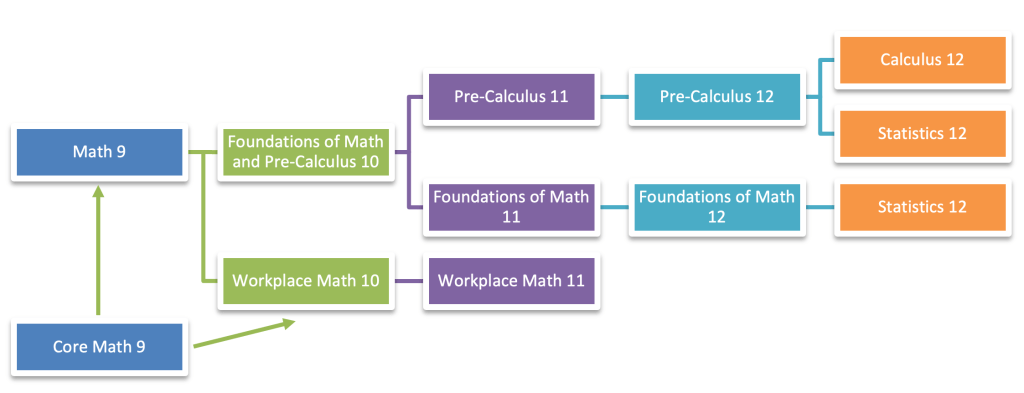
WORKPLACE MATHEMATICS is designed to provide students with the mathematical understandings and critical thinking skills identified for entry into most trades and the work force.
FOUNDATIONS OF MATHEMATICS is designed to provide students with the mathematical understandings and critical-thinking skills identified for most post-secondary programs.
PRE-CALCULUS is designed to provide students with the mathematical understandings and critical-thinking skills identified for entry into specific post-secondary programs, such as sciences and engineering.
Students should consult their math teacher and/or the school counsellor to gain advice on the different math courses.
Workplace Mathematics 10 (MWPM10)
In this course, students will explore a variety of topics including: the SI and imperial units of measurement system, spatial reasoning, 2-D & 3-D Shapes, Pythagorean theorem, primary trigonometric ratios, formula manipulation, geometry, money, and income. Students who successfully complete this course will go on to Apprenticeship and Workplace Mathematics 11.
Foundations of Mathematics and Pre-Calculus 10 (MFMP10)
In this course, students will improve their ability to think mathematically by solving a variety of thinking problems. Students will also explore a variety of topics including: trigonometry, powers, polynomials, factoring, relations and functions, linear relations, and systems of linear equations. Students who successfully complete this course will be recommended to go on to Workplace Mathematics 11, Foundations of Mathematics 11 and/or Pre-Calculus 11.
Foundations of Mathematics 11 (MFOM11)
Foundations of Mathematics is designed to provide students with the mathematical understanding and critical thinking skills identified for post-secondary studies in programs that do not require the study of theoretical calculus. In this course, students will explore a variety of topics including: forms of mathematical reasoning, angle relationships, linear inequalities, quadratic functions, systems of equations, optimization, applications of statistics including normal distribution and financial literacy. Students who successfully complete this course can go on to Foundations of Mathematics 12.
Pre-Calculus Math 11 (MPREC11)
Pre-Calculus 11 is designed to provide students with the mathematical understandings and critical thinking skills required for Pre-Calculus 12 and Calculus 12 which are pre-requisite courses for entry into post-secondary programs that require the study of theoretical calculus. Students will explore the following topics in Pre-Calculus 11: real numbers; powers with rational exponents; radical operations and equations; polynomial factoring; rational expressions and equations; quadratic functions and equations; linear quadratics and inequalities; trigonometric ratios for angles in standard position; sine and cosine laws; and financial literacy. Students who successfully complete this course may go on to take Pre-Calculus 12 or both Pre-Calculus 12 and Calculus 12.
Pre-Calculus 12 (MPREC12)
In this course, students will explore a variety of topics including: angles in standard position (degrees and radians), the unit circle, trigonometric ratios, trigonometric functions, trigonometric equations, trigonometric identities, function composition, function transformations, logarithms, rational, exponential and logarithmic functions, polynomial factoring, polynomial functions, radical functions, rational functions, and sequences and series.
Career Education
Career Life Education 10 (MCLE10)
Career Life Education 10 is a mandatory course.
The Career Education curriculum supports students in the process of becoming successful, educated citizens by providing them with opportunities to explore a variety of careers and options for their future. Students will consider regional and global trends to reflect on career possibilities, refine their understanding of safety requirements associated with occupational areas and related technologies, and further develop and refine their understanding of career possibilities through planning, practice, and application of competencies and knowledge. Students will start to develop their transition plans, which include workplace experience as they work towards developing a final capstone project in Grade 12.
Career Life Connections 12 (MCLC12A / MCLC12B)
Career Life Connections (CLC) 12 is a required course to graduate. CLC provides opportunities for students to explore a wide range of post-secondary education and career options, think critically about health issues and decisions, develop financial literacy skills related to pursuing their education and career goals, and begin planning the actions required to pursue post-secondary destinations and career paths.
Students are enrolled in Career Life Connections 12A in grade 11 (worth 2 credits), and Career Life Connections 12B in grade 12 (also worth two credits). Over these two years, students will experience a variety of career, life, and post-secondary opportunities organized and facilitated by Career Coordinators, Counsellors, Administration, and other teachers.
These experiences include:
- Seminars on a variety of topics, hosted by local
community experts - Field trips to colleges, trades schools and
universities - Mentorships, job-shadowing, volunteerism, and work experiences
- Self-reflection activities such as learning inventories, personality profiles & interests
- Post-Secondary Institution fairs, including application process and admission requirements
- Scholarship and bursary information sessions
- Resume, cover letters and job applications and job fairs
- Budgeting and financial planning sessions
- Health and wellness events and activities
Students will complete their Capstone Project in their grade 12 year while taking this course. This is also a requirement for graduation.
The purpose of the capstone is for students to demonstrate the knowledge, competencies, and passion(s) they can offer the world, as they integrate personal interests and strengths with preferred future possibilities. It is a representation of the student’s learning journey and provides an opportunity to reflect and synthesize as well as showcase and celebrate. There will be both designated times throughout the year, as well as choice for students to complete their Capstone.
Work Experience 12A & 12B (MWEX2A / MWEX2B)
Work Experience 12A & 12B can include volunteer or paid community service in an approved work or volunteer setting to receive 4 credits. Before Work Experience begins, students must complete the in-school and job specific safety orientations before they can begin documenting the 120 hours of work experience. The school Career Coordinator must approve the Work Experience before beginning the program.
Youth TRAIN in Trades Program
The Youth Train in Trades program is the technical training component for an apprenticeship. Students attend a post-secondary institution to receive this training, while still registered as a high school student. This means, they will be away from JL Jackson “training” while receiving both high school credit and college credit. Ideally students take this program in their grade 12 year and should apply in either grade 10 or grade 11.
Upon successful completion of the Youth Train in Trades Program, students can earn between 20 and 28 high school credits. Enrolment in the Youth Train in Trades program is tuition free and paid by the School District (~ $3200). However, students may be required to cover the cost for textbooks, tools, or other items required for working in a specific industry.
Youth WORK in Trades Program
The Youth Work in Trades program is the work-based component for an apprenticeship. Students work under the direction of a Red Seal Tradesperson, while still registered as a high school student. This means, they will be away from JL Jackson “working” while receiving both high school credit and hours toward certification in their trade.
The benefits of this option include:
- Students can begin as early as grade 10, or 15 years of age.
- Students work with an employer that has been approved as an ITA sponsor.
- Students are paid by the employer.
- Upon successful completion of 480 work-based hours, students receive 16 high school course credits.
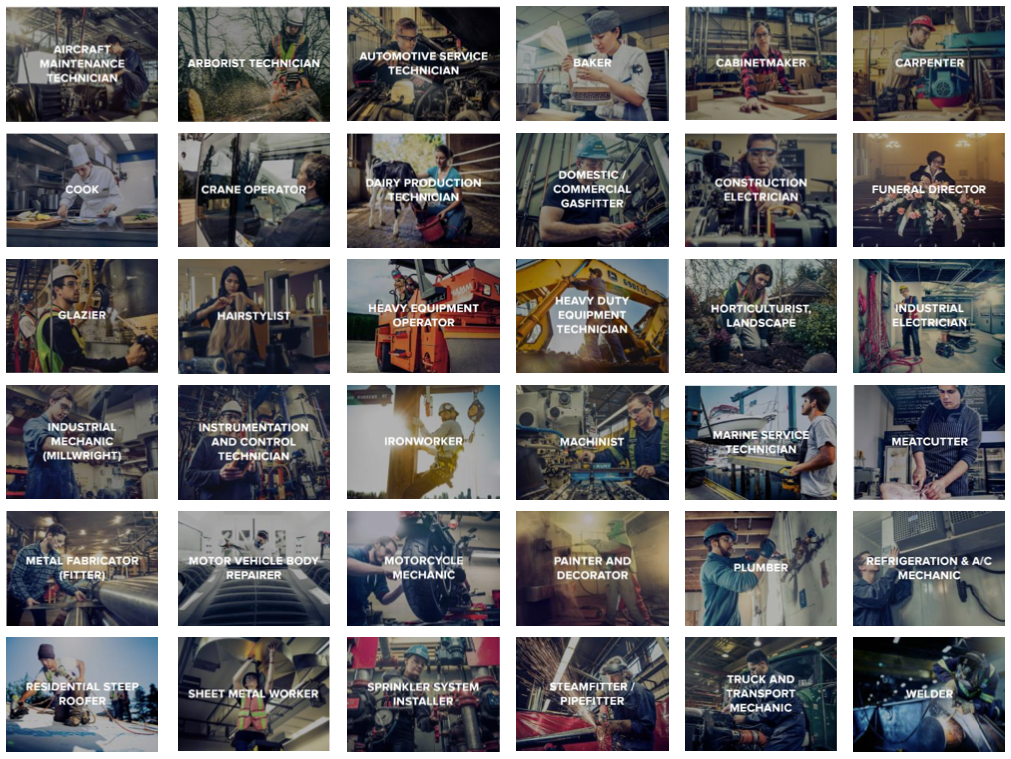
These are just some of the trades available to explore:
Physical Education
Physical Health Education 10 (MPHED10PHE)
PHE 10 is a participation-based course focusing on well-being and the connections between physical, intellectual, mental, and social health. Students experience a variety of individual, dual and team activities to develop a personalized understanding of what healthy living means to them as individuals and members of society. The aim of PHE 10 is to gain the knowledge, movement skills, positive attitudes and behaviours that contribute to lifelong physical health and mental well-being.
Active for Life 10 (MPHED10AFL)
This course provides an opportunity for students to achieve credit for PHE 10 in a less competitive PHE setting. Fundamental movement skills will be taught and evaluated using less complex-skills based activities than some traditional sports. This allows students the opportunity to discover a variety of activity settings that they can continue to pursue for lifelong active living. Students will have the opportunity to work on their individual fitness through learning principles of fitness, and working through a variety of fitness activities such as strength training, cardiovascular training, stretching, and game play. Students will also investigate other aspects of healthy living by learning about the importance nutrition, healthy sexual decision making, mental health, sleep, avoiding substance abuse and addiction, and first aid/CPR.
Fitness and Conditioning 10 (YHRA10A)
Fitness and conditioning classes are run within our daily block schedule. Fitness and Conditioning is designed for students who have an interest in developing overall fitness. This course will offer students the skills, knowledge, and attitude to incorporate strength training, agility, plyometrics, flexibility and cardiovascular fitness into their personal training regime and lifestyle. It will teach students:
- The fundamentals of strength training;
- The lifelong benefits that a variety of physical training programs have to offer;
- Proper training methods and techniques for strength training, agility, plyometrics and flexibility/mobility;
- How to plan and follow personal training programs; and
- Basic muscular anatomy
This is a physically demanding course and is developed for students who are serious about improving their overall fitness and willing to challenge themselves physically. This course can also be personalized for high-level athletes with performance-based goals.
*Fitness and Conditioning 10 does not fulfill the grade 10 PHE course requirements as the health curriculum is not covered. This is an additional elective course in physical education*
Active Living 11 / 12 (MACLV11 / MACLV12)
The Active Living 11 / 12 curriculum focuses on promoting healthy attitudes and regular physical activity as important parts of each student’s lifestyle. Through the promotion of teamwork, leadership, sportsmanship and participation, students will be provided with opportunities in both skill-related games and health-related fitness and health-promoting activities. The Big Idea in Active Living 11/12 is to safely expose students to a variety of enjoyable activities to be able to maintain a lifelong, healthy lifestyle.
This course is for students who have enjoyed PE classes in the past.
Fitness & Conditioning 11 / 12 (MFTCD11 / MFTCD12)
This advanced fitness course is designed for students who have completed Fitness and Conditioning 10, or AM Fitness 10 and are looking to take their training to the next level. Students will develop and follow individualized fitness programs tailored to their personal goals, athletic performance, and overall well-being. Whether training for a specific sport or focusing on general strength and conditioning, students will apply fitness principles, advanced training methods, and recovery strategies to enhance their physical performance. Through goal setting, progress tracking, and self-assessment, students will build a deeper understanding of fitness and conditioning while improving their overall health. This course encourages self-motivation, discipline, and lifelong fitness habits in a supportive and structured environment.
Science
Science 10 (MSC10)
Science 10 allows students to further develop their scientific knowledge and skills in a variety of ways, including laboratory work. Topics include biology (genetics), chemistry (chemical processes), physics (energy conservation and transformation), and earth and space science (formation of the universe).
Chemistry 11 (MCH11)
Chemistry 11 continues the exploration of atoms and molecules and how they interact in the world around us. Familiar concepts such as naming and formula, predicting products and reactants, and balancing chemical equations will be furthered developed in Chemistry 11. Beyond topics they have been introduced to previously, students will explore and develop competency in the following general areas of chemistry: the structure of matter (beyond the Bohr model), the quantification of matter (via the concept of the mole and stoichiometry), organic chemistry, and solubility and the factors that affect how materials dissolve. Along with the theoretical components of Chemistry 11 there will be opportunity to engage in practical lab work in the realm of basic chemical analysis and investigations of reactivity. Science 10 can be completed concurrently with Chemistry 11.
Environmental Science 11 (MEVSC11)
This course further develops student understanding of ecosystems and how matter and energy move around the world. Students will investigate the properties and components of ecosystems by reviewing a variety of environments and analysis techniques used by scientists to generate knowledge. Students will closely examine a variety of ecosystems, (locally or globally) and will learn how these powerful Earth systems interact and change over time. Throughout the course, students will learn how humans can be positive or negative forces affecting our environment and how these effects can have far reaching and lasting consequences. Class and lab activities will look at how human actions can affect our air, land and soil. The course draws on components of biology and chemistry, so it is recommended that Science 10 is done before this course, however, exception can be made.
Life Science 11 (MLFSC-11)
Life Science 11 is an introductory biology course that delves into the unifying characteristics of living things, how they change over time and how we have categorized them. Different cells, their structures and processes, DNA, as well as viruses and their infection cycles will all be examined through a variety of labs and hands-on activities. Change in organisms over time in nature and through human intervention will be investigated. A significant portion of the course will be devoted to the comparison of organisms in each of the six kingdoms (Bacteria, Archea, Protists, Fungi, Plants, Animals) with particular attention devoted to the animal kingdom. Some dissections of animals such as earthworms, locusts, crayfish, squid and sea stars will be performed – along with microscope work – to compare the anatomy of various organisms. Science 10 may be completed concurrently with Life Science 11.
Physics 11 (MPH11)
Physics 11 introduces students to theories that explain everyday physical phenomena, such as the motion of a car during a collision or the alteration of images with lenses or mirrors. The course will extend Science 10 coverage of energy and investigate motion, forces, and waves. Through laboratory work, students will develop an experiential understanding of the fundamental principles behind numerous theories. Labs will involve the collection of data through a variety of instruments and the subsequent analysis of this information. Solid attendance and strong math skills are required for this course. It is highly recommended that Pre-Calculus 10 be completed the semester prior to undertaking Physics 11. Science 10 may be completed concurrently with Physics 11.
Anatomy and Physiology 12 (MATPH12)
This course was previously known as Biology 12. Some previous knowledge of Life Sciences 11 and Chemistry is helpful. Anatomy and Physiology 12 is an interesting, informative course on the inner workings of living things, with emphasis on the human body. The course covers cell and human biology. Cell biology deals with biological molecules, cell structure and function, enzyme action, DNA, and genetic engineering. Human biology studies the anatomy and physiology involved in digestion, circulation, respiration, excretion, reproduction. Each system involves developing an understanding of nervous control and hormonal regulations. While studying human physiology you will carry out dissections on the corresponding systems in a fetal pig.
Social Studies
Social Studies 10 (MSS10)
Social Studies 10 is a survey course, which means that it will introduce a wide variety of topics in modern Canada around “Big Ideas” rather than go into detail on a few topics. The historical emphasis is more on Canadian content than in grade 9 Socials.
The “Big Ideas” will include:
- How global and regional conflicts have been a powerful force in shaping our contemporary world and identities.
- Investigate how the development of political institutions is influenced by economic, social, ideological, and geographic factors.
- Analyze how worldviews lead to different perspectives and ideas about developments in Canadian society.
- Recognize how historical and contemporary injustices challenge the narrative and identity of Canada as an inclusive, multicultural society.
Social Studies 11 (MEPSS11)
Explorations in Social Studies 11 is an overview course – providing students with a variety of learning experiences, using numerous areas of content (i.e. government, law, history, politics, geography, indigenous culture, philosophy, and social justice) to further develop the necessary knowledge, skills, and understandings required for more specific and focused grade 12-level courses. Topics include:
- World History from World War 1 to the end of the Cold War.
- Politics – What is the study of Politics and why do we study this area.
- Economics – How various economic strategies affect what we buy and how we can benefit/lose.
- Human and Physical Geography – the study of how we relate to one another, and what we can do to improve our way of life and the environment.
- Social Justice – how the principles of Social Justice relate to issues and dilemmas in social media as well as everyday life; its relation to the Law, injustices within Canada and the World, including Genocide.
20th Century World History 12 (MWH12)
20th Century World History 12 is an advanced social studies course tracing history from the aftermath of World War I to the end of the Cold War. Topics include: the rise and fall of the Soviet Union, the predominance of the USA as a superpower, the role of conflict, the role of technology, the United States civil rights movement, the changing role of women and the decolonization in Africa and Asia in the 20th century. A major research essay/project is a requirement of the course.
BC First Peoples 12 (MBCFP12)
BC First Peoples 12 enables students to understand and respect the identities, worldviews, traditions, values, and beliefs of the BC First Peoples. This will be achieved through investigating and analyzing the past, present and future of BC First Peoples, including the political, social, and economic impact of contact and colonialism, as well as how cultural expressions convey the richness in diversity and resiliency of BC First Peoples.
Comparative Cultures 12 (MCMCL12)
Comparative Cultures is, at its core, the human story – from the very earliest humans to the rise and diverse expressions of culture and civilization across the globe. Students will journey through the paleolithic right up to the modern day, exploring how geography and other factors shape human settlement and cultures; how class and culture intersect in how different societies structure themselves; and a myriad of other possible topics and regions subject to student interest! The intent is to gain and enrich an understanding of the incredible scope of human history and accomplishments, and how this can foster a deeper appreciation for the staggering breadth of what we call “humanity”.
Physical Geography 12 (MPGEO12)
Physical Geography 12 explores how our Earth’s physical features work together. We’ll dive into topics like landforms, ecosystems, extreme weather, and natural dangers. We’ll learn about things like earthquakes, erosion, and weather patterns to understand how they create the world around us. We’ll also look at climates, different types of environments, and how water moves on Earth. Further, we’ll consider the impact of human activities on the physical environment emphasizing the importance of sustainable practices. Through a mix of hands-on activities, field study, online simulations, research, inquiry, and learning, we’ll gain a deep understanding of our physical Earth and our role in keeping it healthy.
Languages
Note: Some universities require a second language 11 for direct admission from high school; some programs require a second language 12. Check university calendars for specific admission requirements.
Core French 10 (MFR10)
Core French 10 is a continuation of the Core French 9 program. All four components of language are taught: speaking, listening, reading, writing. Students will continue to learn useful expressions and vocabulary and basic grammar will be covered. Active participation is encouraged through games, skits, videos and presentations.
Core French 11/12 (MFR11 / MFR12)
Core French 11 is intended for students who have already taken Core French 9 and 10. This course is designed to help you become competent in speaking and writing French. Cultural topics will also be explored by reading stories and by watching movies. Core French 12 is a continuation of the French 11 program. The students will broaden their range of vocabulary, strengthen their grammatical structures learned in gr. 11 and improve their conversational French. Cultural topics will also be explored in French and English by reading stories and by viewing movies.
Japanese 10 (MJA10)
Japanese 10 is the 2nd year of Japanese study, and is designed to prepare students for Japanese 11, and to build upon their oral and written communication skills. Students are expected to be proficient in Hiragana, and by the end of the course they will be able to read and write about 50 Kanji and Katakana words. Topics to be covered include Japanese schools and a typical school day, discussing trips and free time activities, and talking about where and when you were born. Please keep in mind that our city and school district have a student exchange program with the city of Inashiki in Japan; this trip is an excellent way to practice your Japanese.
Japanese 11/12 (MJA11 / MJA12)
Japanese 11 is intended for students who have already taken Japanese 9 and 10.
The Japanese 11 course is intended for those students who already have some knowledge of the Japanese language. Students should feel relatively comfortable with the hiragana and katakana syllabary. There will be an emphasis placed on writing, listening comprehension and memorizing approximately 100 Chinese characters, i.e. Kanji.
In Japanese 12, a great deal of emphasis is placed on writing at a more sophisticated level.
Fine Arts
Music
Intro to Guitar 10 (MMUGT10)
This course will introduce new players to the basics of playing the guitar while challenging guitarists that are more experienced to take their skills to the next level.
Guitar 11/12 (MIMG11 / MIMG12)
This is a semester-long course. Guitar 11/12 is a course where students of any level of experience, from beginner to expert, can come to refine their abilities and learn more about this flexible instrument. Students will work in individual and group settings to practice and perform various styles of music: from rock to indie, to folk and traditional. Students will learn to read chord symbols, tab, and standard notation, and will be encouraged to explore music that is of personal interest.
Choir 10 (MMUCC10)
Past students have said that this class is the best part of their school day! This course is for you if you love to sing and want to become better singer. We will explore a variety of music and musical styles from traditional choral repertoire to popular music. We will contribute to our school and community by spreading joy and sharing our love of music through local performances. No previous experience is necessary.
Choir 11/12 (MCMCC11 / MCMCC12)
Choir is for any student wishing to engage in vocal music-making in a variety of unique styles and methods. We focus strongly on vocal health, building musicianship and music literacy skills, expanding our technical and expressive abilities, and what it means to be a musician. In choir students will find themselves challenged by a selection of different genres and contexts in their music, along with an ever-evolving purpose behind why we make music. Overall, students will find choir to be a welcoming, exciting experience where they can take risks and explore their voice in a safe and encouraging environment. No previous singing experience or music-reading is necessary.
Concert Band 10 (MMUCB10)
Concert Band 10 advances the work done in Concert Band 9. As this is a more advanced band, it is recommended for students who have completed Concert Band 9 or for highly motivated students who are committed to bringing their level of playing up to that of the class. Since students have a greater mastery of basic playing skills, our focus will be on expression and more advanced instrumental technique. Concert Band 10 is a performance course that requires energy and focus from all members of the group. Some performances will occur outside the timetable. Woodwind, brass, percussion, and string instruments are all welcome. This is a year-long course.
Concert Band 11/12 (MIMCB11 / MIMCB12)
Concert Band is an opportunity for students to refine their musical and technical abilities through work in a wide selection of music genres. Students will use woodwind, brass, string, or percussion instruments to perform in a large ensemble setting for a variety of audiences. This can include performances in the school, the community, and in festivals outside of town. Music is used as a medium to explore genre, historical and cultural context, roles of the performer, and advanced musical vocabulary. Overall, students will find concert band to be a strong, encouraging, and fun community where everyone has the space to experiment and grow as people.
Drama
Drama 10 (MDRM10)
This performance-based course is intended for students in grade 10 who have completed Drama 9. Students in this course will continue to work on the development of performance techniques specific to acting, directing, and script development. Commitment to a performance ensemble is expected.
Drama 11 (MDRM11)
This is an inclusive and welcoming acting class for both new and experienced Drama students. In this course, students will develop a repertoire of dramatic skills and techniques through presentation and performance. Students will create, rehearse, and refine dramatic works through collaborative and individual presentation or performance. Topics covered may include movement, voice, improvisation, script study, genre, scene preparation, and technical theatre, etc.. Individual and group projects are assigned on a regular basis.
There is no large-scale, end of semester production in Drama 11.
Musical Theatre 10-12 (MMUTH10 / MMUTH11 / MMUTH12)
Dive into the world of musical theatre with Musical Theatre 10 & 11, where you will experience the full journey of creating a production—auditioning, rehearsing, and performing. This course combines acting, dance, and music to bring meaningful stories to life on stage in JL Jackson’s Little Black Box Theatre.
Explore your creativity to overcome technical and spatial challenges while learning the etiquette and professionalism essential to theatre-making. Whether you’re a performer or prefer behind-the-scenes roles, there’s a place for you! Opportunities abound for stage managers, light and sound operators, crew members, costume designers, marketers, and more.
Join a supportive ensemble and discover the power of collaboration as you work together to create a spectacular musical production. No matter your skills or experience, this course offers a space for everyone to shine!
Theatre Company 10-11 (MDRTC10/ MDRTC11)
Step into the world of theatre with Theatre Company 10 & 11, where you will explore the full process of producing a play—from auditions to rehearsals and live performances. Develop your skills in voice and movement to create engaging characters and work with scripts to bring meaningful stories to life in JL Jackson’s Little Black Box Theatre.
Engage your creativity to tackle technical and spatial challenges while mastering the etiquette and professionalism essential to theatre production. Not interested in acting? There are plenty of opportunities for stage managers, light and sound operators, crew members, costume designers, marketers, and more.
Join a collaborative ensemble and experience the magic of teamwork as you bring a live theatre performance to fruition. Whether on stage or behind the scenes, this course offers something for everyone passionate about storytelling and live theatre..
Visual Arts
Art Studio 10 (MVAST10)
This is the perfect course for those wishing to learn to appreciate the arts and for those wishing to study further towards any career in the booming visual arts world. An emphasis is on learning to draw, paint, sculpt, print make, dye, and create glaze pottery. You will use the principles and elements of design, image development strategies and appreciate the development and significance of art through history, in different cultures, as well as in contemporary times. This course will provide a solid foundation in visual arts and will prepare you for further visual arts classes.
Art Studio 11 (MVAST11)
This course is intended for students in grade 11 or 12 who are first time art students, or experienced artists! In Art Studio 11 students will explore both 2D and 3D art forms. Students can expect an active, “hands-on” environment with a wide variety of projects to build skills and confidence. The areas covered include drawing, painting, ceramics, sculpture, printmaking, graphic and fabric design.
Studio Art 2D 10 (MVAD10)
This course is intended for students who have already completed Art Studio 10 and requires students to work more independently on their coursework. Studio Art 2D will offer students a mix of applications in art with the main focus on drawing and painting. Projects will use traditional media like acrylic paint, watercolour, oils as well as an extensive exploration of drawing media such as charcoal, ink, and pastels. Students will be looking at specific historical artists who have advanced 2-D works.
Studio Arts 2D 11 (MVAD11)
This course is for students who wish to engage in a focused and in-depth study and creation of works of art primarily on a two-dimensional surface, for example, drawing, painting, printmaking, graphic design, and textiles. Students can expect a challenging environment with the opportunity for independence and personal choice. As well as covering a wide variety of primarily painting and drawing techniques, this course may allow students to integrate photography, digital technology and portfolio building if desired.
Studio Art 3D 10 (MVAC10)
This course is intended for students who have already completed Art Studio 10 and requires students to work more independently on their coursework. In Studio Art 3D you will explore more deeply 3-D works in a variety of media. We will focus on clay, both on the wheel and hand-building. The student will also have the opportunity to try different carving techniques and the use of wire and the creation of forms for plaster. We will be researching sculpture in a historical context as well.
Applied Design, Skills and Technologies (ADST)
Foods
Foods Studies 10 (MFOOD10)
Do you have a “passion for food and a flair for cooking?” Learn to prepare delicious meals for you and your friends. Focus on your personal skills and preparation techniques while exploring recipes from around the world, as well as how food choices contribute to your health and well-being.
Food Studies 11 (MFOOD11)
This is a senior course that focuses on food preparation principles and techniques, food products, nutritional and social-economic issues. You will get to develop your creative thinking skills through learning a variety of cooking techniques and styles. You will develop your critical thinking skills by learning how to personally apply nutritional science to better your own diet and lifestyle. Through collaboration with cooking partners and Master-Chef style competitions, you will have many chances to test your new cooking knowledge and skills!
Computers & Technology
Computer Studies 10 (MCSTU10)
Want to learn how to use technology in new creative ways? Want to go beyond being a user and become a creator? Learn how to maintain or even build your own computer. Want to maximize your online computing, modern internet tools, and other useful computer skills? Learn how to make interactive programs (text-based adventures)? Computer Studies 10 is designed to help students go from being users who consume content to software creators who make original content. A good portion of this course is dedicated to projects so come ready to learn, create, and share.
Computer Programming 11/12 (MCMPR11 / MCMPR12)
Computer programming is an exciting and growing field with career opportunities across the world. Students will learn to program with C# (desktop-based applications) and Javascript, HTML and CSS (web-based programming languages). Students will learn to incorporate the use of ChatGPT as a tool in programming. Computer programming is a fun and exciting way to explore technology- and this is a great course for those interested in post-secondary studies in game design, engineering, information technology and other related fields. In Computer Programing 12 students learn advanced programming skills in C#, Javascript and database development- and take their skills to the next level! Students
may also choose to develop smaller scope projects that incorporate these advanced skills or a larger passion project such as graphics programming or game design (with Fusion or Unity).
Media Design 10 (MMEDD10)
This course is an introduction to all aspects of Digital Art and Design and is developed to give students a view into media technologies for image development and design. Through engaging and personalized projects, students will build fundamental skills through the use of a variety of software, covering areas such as: elements of design, principles of design, image development strategies, standards-compliant technology and a range of processes and techniques.
Graphics Media Design 11 (MMEDD11)
Calling all art and photography students! If you can draw or paint this course is for you! This is a computer graphic design course for students who have an interest or talent in art and want to transfer those skills to the digital world. Come and learn 2D graphic design using industry-standard software such as Adobe Photoshop and Illustrator. Create exciting visual art, including your very own character (and character animations!). Other possibilities include video production and or stop-motion animation. This course is excellent for students interested in careers in art, photography, design, interior design, architecture, graphic design, production and or advertising.
Electronics and Robotics 10 (MTEAR10)
We explore world of electronics through the Arduino, discovering ways to interact with the world around us, gather information and react autonomously. We then use and advance those skills to design and create robots to complete challenges. There are lots of design and interactive learning opportunities in Electronics and robotics 10.
Robotics 11/12 (MTROB11/MTROB12)
This is an exciting course where we will be building and programming robots. Students will be engaged in project-based learning where they will expand their creativity, critical thinking, and problem-solving strategies to build increasingly complex robots. Great for students thinking about a career in engineering, programming, mechatronics, or robotics!
Engineering 11 (MENR-11)
Engineering 11 focuses on 5 units; drafting and design, magnetic levitation, compression and tension, hydraulics and electricity. Each unit encompasses a project that will allow you to apply theoretical knowledge to a practical application. Students will integrate basic science, mathematics and manufacturing skills within the project design, the build, and their lab reports.
Trades & Technology
Metal Work 10 (MTMET10)
This course introduces students to metal fabrication and mechanical technologies through a variety of projects and skill-building labs. Students will learn to properly use hand and layout tools as well as oxy-acetylene torches, a mig welder, aluminum welding, plasma cutter, drill presses, metal lathe, and other shop equipment.
Metal Work 11 (MTMET11)
No previous experience necessary. This metalworking course builds upon the knowledge acquired in Metalwork 9/10. However, for students with little or no previous metalworking experience this course will be adjusted to suit their own goals and abilities and may follow a program similar to the metalwork 9/10 course. For students with prior skills this course provides the opportunity to further develop and refine their knowledge of metalworking tools and processes. Students with prior experience will be required to build a mandatory project and then have the opportunity to design and build their own projects based on their skill level or complete teacher assigned projects. Please note: most projects will be self-designed and projects requiring a greater amount of material will include additional costs to the student.
Woodwork 10 (MWWK10)
Woodwork 10 continues to build upon the skills students learned in Woodwork 9. Creative designs and ideas, where appropriate, are encouraged! Projects include challenging boxes, casework projects and furniture. Students with an aptitude / interest in a higher tech focus are encouraged to learn the MasterCAM software package in our mini lab. This knowledge can then be applied to learning how to use the CNC (computer numeric controlled) Router and experiencing a whole new world of project possibilities! As always, additional projects are possible, depending upon time in the course. Working in a safe and cooperative manner is emphasized throughout the entire course.
Woodwork 11 (MWWK11)
This is a shop-based course that builds upon the skills students learned in Woodwork 10. Students build a variety of furniture projects such as coffee tables, end tables, chairs, and various types of cabinets. Students will work with a variety of softwoods & hardwoods to build these projects.
Woodwork 12 (MWWK12)
This is a shop-based course for students familiar with woodworking tools and techniques. Students will have choice to build a variety of projects such as tables, entertainment cabinets, beds, and desks. Students will work semi independently, planning out their project choices in consultation with the instructor.
Business Education
Entrepreneurship and Marketing 10 (MADEM10)
Are you interested in owning your own business? Come learn about business models, marketing strategies, stocks, bonds, ETF’s, and anything else that pertains to making unlimited money in a free market economy. This elective has access to technology, including digital cameras, and will allow for class interests to be explored.
Accounting 11 (MAC-11)
Accounting 11 is an introductory business course based on generally accepted accounting principles. Accounting 11 provides both manual and computer-based accounting practices. It provides basic accounting knowledge and practical applications for those students interested in managing their own finances, as well as an introduction to accounting for a service-based business. Included in the course are personal income tax, investing, and personal budgeting units. Work experience possibilities are available for students who are interested in connecting their learning to the real world.
Out of Timetable Courses
Leadership 10-12 (YIPS0A / YIPS1A / YIPS2A)
This course is designed to give students an awareness of social and civic responsibility as well as an understanding of effective styles and methods of leadership. These are all demonstrated through class and group projects that leadership students will undertake. Running the school store, school dances, community fundraisers, intramurals and supporting school assemblies and events are some ideas – but please bring your own! This course is highly customizable, and relies on teamwork.
Yearbook and Journalism 10-12 (YPA0A / YCCT1A / YCCT2A)
This class designs and produces the school yearbook as well as other student online and print publications. Students will learn how a book is published, and will be responsible for all writing, design and photography that will appear in the school yearbook. In order to do this, students will learn skills in Journalism and computer software necessary to produce the yearbook. In addition, students will learn the business skills required to fund a book through sales to students.This class is held outside of the timetable and the class schedule will be determined in early fall.
AM Fitness and Conditioning 10-12 (YHRA10A / MFTCD11AMF / MFTCD12AMF)
AM Fitness and Conditioning classes are held in the morning before school. AM Fitness and Conditioning is designed for students who have an interest in developing overall fitness. This course will offer students the skills, knowledge, and attitude to incorporate strength training, agility, plyometrics, flexibility and cardiovascular fitness into their personal training regime and lifestyle. It will teach students:
- The fundamentals of strength training;
- The lifelong benefits that a variety of physical training programs have to offer;
- Proper training methods and techniques for strength training, agility, plyometrics and flexibility/mobility;
- How to plan and follow personal training programs; and
- Basic muscular anatomy
This is a physically demanding course and is developed for students who are serious about improving their overall fitness and willing to challenge themselves physically. This course can also be personalized for high-level athletes with performance-based goals.
AM Basketball 10-12 (YHRA10B / MFTCD11BB / MFTCD12BB)
A.M. Basketball is designed to develop player fundamentals as well as strength & power, speed/quickness, agility, and balance & coordination. This course has been created to support and encourage students to develop their individual basketball skills, physical strength and conditioning, health and nutritional knowledge, team building skills, and goal setting and organizational skills in a basketball setting. Students will be expected to maintain a written journal reflecting on weekly workouts and skill development. The basketball class is a natural progression from a regular physical education class to a sport specific class that enables student/athletes to maximize their academic and athletic potential.
Athletic Leadership 10-12 (YCPA10A / YIPS1B / YIPS2B)
This is a yearlong course, scheduled outside the timetable. On average, students can expect to meet at lunch or after school 2 times per week throughout the year. This is a leadership course with specific emphasis on athletics. Students will work with the school’s Athletic Director and be involved with planning, organizing, promoting, and operating school sporting events and activities throughout the school year. Course activities include the JLJ intramurals program, managing and promoting school sports teams, assisting with home games and score table duties, and facilitating school sports tournaments. Students will also learn about the BC School Sports organization, the basic care & prevention of injuries, as well other school-sports management concepts.
AM Jazz Band 10 (MMUJB10 / MIMJB11 / MIMJB12)
This course is open to all instrumentalists with at least two years of band experience. Preferred instruments are: saxes, trumpets, trombones, drums, bass, piano and guitar. Other instruments may be included in consultation with the instructor. This is a performance group that will develop your ability to improvise and play a variety of styles, including Swing, Latin, Rock, Funk, and Blues. A high level of commitment and focus will be required from students during class and in performances. Attendance is mandatory at all classes and performances, some of which occur outside the timetable. Final enrolment and instrumentation will be determined in the early fall.
This course is offered outside the regular timetable. The class schedule will be determined in early fall.
Specialized Programs & Academies
Mountain Bike Academy
Students in this half day Spring Semester program will earn credits for two courses, an elective course called Mountain Biking Community Development 10 and for PHE (one of PHE 9 or 10, or Outdoor Education 11 or 12). This is a fee-based academy program. Candidates must complete an online expression of interest form prior to being considered for the program. Entry into the academy is prioritized for students in Grade 10.
Course topics include:
- Mountain biking skill development
- Bike mechanics, maintenance and repair
- Sustainable trail planning, development, construction and maintenance
- Strength and conditioning for mountain biking
- Principles of physical fitness
- Wilderness emergency response
- Sports psychology
- Sports nutrition
Questions? Please email Chris Stromgren – cstromgr@sd83.bc.ca
Interested? Please complete an expression of interest here
Outdoor Adventure and Design
This 2 block course during the 2nd semester gives students the opportunity to obtain a Wood Working credit in addition to a Physical Health Education credit. It is important to note that this is a fee based program.
In this half day course, students will be immersed in hands on physical activity and woodworking projects. With a focus on the outdoor curriculum, students could participate in activities such as building fish nets and fly boxes then using them at local steams and lakes; hiking and learning the use of many local plants and berries; studying the benefits of different types of hardwoods and softwoods for drum creation, shelter use, and fire building; participating in geocaching and create puzzle box caches; building camp chairs and learning how to prepare for outdoor excursions; enjoying winter activities such as curling, snowshoeing, skating, xc skiing and quinzhee building. Of course, these activities will be decided at the time of the course and availability of resources.
Questions? Please contact Tiffany Lombaert or Stephen MacInnis
Interested? Please complete an expression of interest here.